
October 24, 2026
Best Classroom Economy Apps in 2026
A classroom economy is one of the oldest tricks in the teaching book. Students earn a classroom currency for effort,
behavior or learning, and spend it on rewards they care about. Done well, it teaches responsibility, delayed
gratification and sometimes real money skills. Done badly, it becomes a pile of paper money and a lot of bookkeeping.
Apps can take most of that bookkeeping away. But they're not all trying to do the same thing. Some simulate a real
economy with bank accounts and bills. Others use a currency as one part of a bigger game.
Full disclosure: we make ClassMana, one of the options below. We've tried to be fair, and
we'll say clearly when another option is a better fit. Information about other products comes from their public websites
as of October 2026.
How we picked: what to look for
We looked at four things:
- Realism vs. simplicity. Do you want students to learn about salaries, savings and bills? Or do you just want a currency that motivates, without extra admin?
- Time to run. Every transaction you have to enter is time out of your lesson. Look for quick awarding and automation.
- The store. What can students buy, and how do you handle stock and redemption?
- Staying power. Does the system still motivate students in spring, or only in September?
We also looked at cost, who can sign up (a single teacher or only the whole school), and how much student data is
needed.
ClassBank
Best for: teachers who want a realistic economy that teaches financial literacy.
ClassBank is a digital classroom economy built around money. Students have checking and savings accounts, hold classroom
jobs like Banker, Librarian or Store Clerk, and receive paychecks. Teachers can optionally add bills, rent and fines.
There's a class store, and the Pro plan adds interest, inventory tracking, co-teacher access and data exports. Schools
and districts can get dashboards for behavior, engagement and attendance.
Pros:
- A free teacher plan with unlimited students and no credit card
- Real financial-literacy concepts: saving, interest, salaries and bills
- Classroom jobs give students responsibility
- Affordable Pro plan ($100 per year or $12.50 per month)
Cons:
- It's an economy, not a game: no avatars, levels or boss battles
- A realistic economy takes some setup and ongoing management
Read more: ClassMana vs ClassBank
Critter Coin
Best for: schools that want a school-wide coin economy with houses and collectibles.
In Critter Coin, students earn digital coins with values you configure. Coins count toward both their house score and
their own balance in a rewards store, where purchases are redeemed with QR vouchers and students can act as store
clerks. On top of that are collectible critters, virtual pets students can care for with their points, and an optional
shared 3D world. An AI setup wizard can generate coins and houses from your school's mission statement.
Pros:
- A free core (houses and rewards store) for a school's first 20,000 coins
- Strong gamification around houses, pets and collectibles
- Students don't need logins
- Web, iOS and Android apps, with Clever and ClassLink support
Cons:
- Designed for school-wide setup, rather than a single teacher starting alone
- Extra features are monthly add-ons, so the cost depends on what you choose
- Its focus is houses and character building, rather than money concepts like saving or interest
Read more: ClassMana vs Critter Coin
ClassMana (gold and the class shop)
Best for: teachers who want a lighter economy inside a full classroom game.
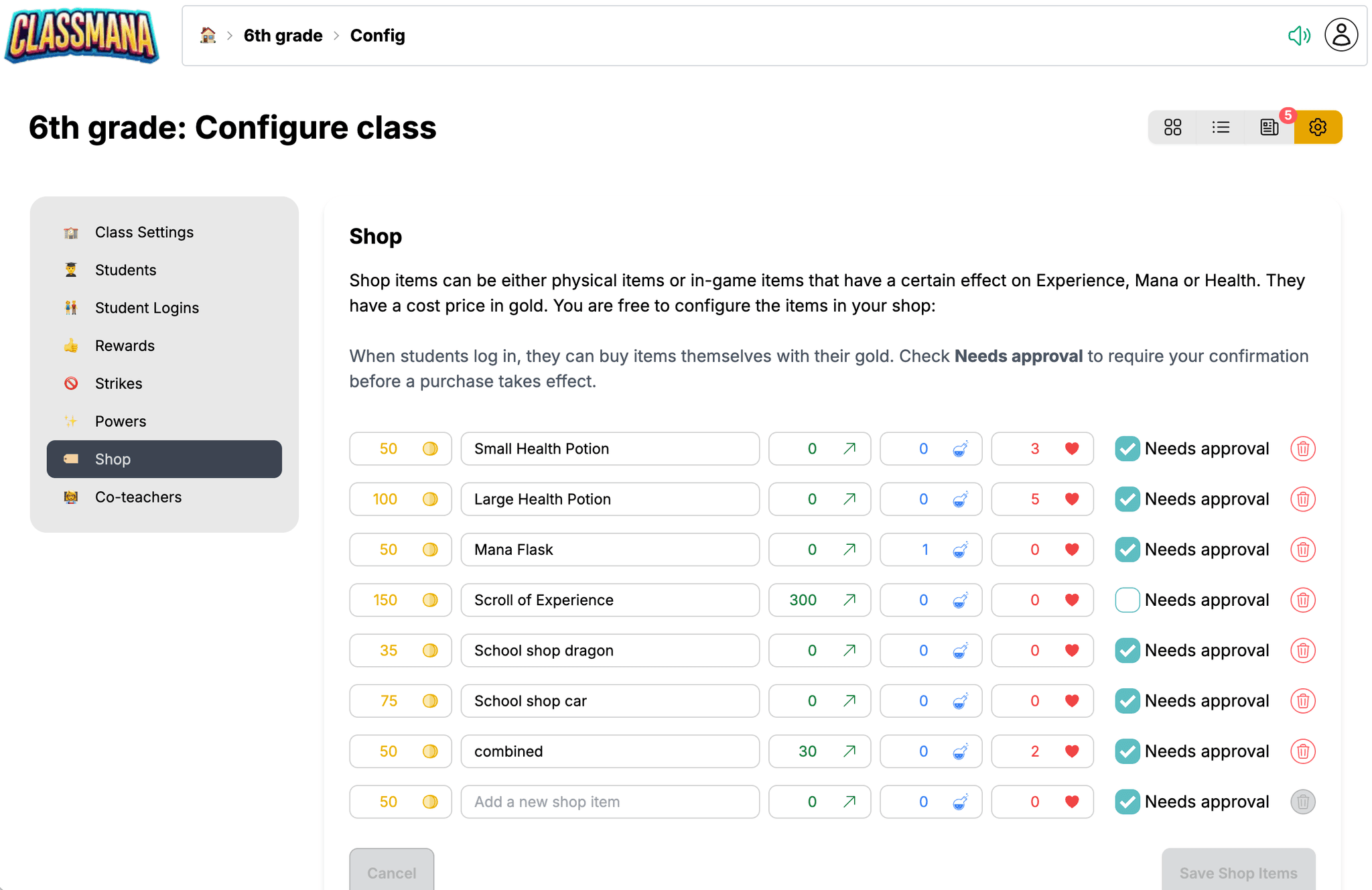
ClassMana is a gamified classroom management app, and its economy is deliberately simple. Students earn gold (for
example for academic milestones) and spend it in a class shop with items you define, like a sticker or a small
prize. That's it: no paychecks, no rent, no interest.
What makes it different is everything around the gold. Rewards give Experience, which levels up each student's
animated 3D avatar across 35 levels of gear. Students earn mana to spend on powers (classroom privileges), and
warnings lower health without taking anything away. Teams, Monster Battles, the Silence Challenge and Mystery Events
keep it fresh all year. So students aren't only working for the next shop item; they're working on their character.
If several teachers use ClassMana, you can share your shop items, rewards and powers across classes, so a
grade-level team runs the same economy. The Activity Log shows every purchase per student and per period.
Pros:
- Almost no bookkeeping: run it in seconds during a lesson
- The economy is part of a game with long-term progression, which helps it stay motivating
- A single teacher can start today; students log in with their name and a login code, no emails needed
- Works from primary through high school
Cons:
- No banking, jobs, salaries or interest, so it's not a financial-literacy tool
- No parent messaging and no native apps (it's a mobile-friendly web app)
- Paid after the free trial: from $65 per year per teacher, or the School plan from $1 per student per year (minimum 150 students). See pricing.
DIY: spreadsheets or paper money
Best for: teachers who want full control and have the time to run it.
Plenty of teachers run a great classroom economy with printed bills, a ledger, or a shared spreadsheet. You decide every
rule, it costs nothing (apart from printing), and students handle something tangible, which can be valuable with younger
classes.
Pros:
- Free and fully customizable
- Tangible money can make concepts concrete
- No accounts or student data in any app
Cons:
- Lots of manual bookkeeping, which tends to slip during busy weeks
- Paper money gets lost, traded or "printed" by creative students
- Hard to share with co-teachers or keep consistent across classes
- No built-in game or progression to keep students engaged
Summary table
| Option | Type | Single teacher can start | Banking / jobs | Store | Game layer | Price |
|---|---|---|---|---|---|---|
| ClassBank | Realistic economy | ✅ | ✅ | ✅ | ❌ | Free; Pro $100/yr |
| Critter Coin | School-wide coin economy | ➖ School-wide setup | ➖ Store clerk roles | ✅ QR vouchers | ✅ Houses, pets, collectibles | Free core + monthly add-ons |
| ClassMana | Economy inside a game | ✅ | ❌ | ✅ Class shop | ✅ Avatars, levels, powers, battles | From $65/yr per teacher |
| DIY | Paper or spreadsheet | ✅ | ➖ If you build it | ➖ Manual | ❌ | Free |
Last updated: October 2026. Features and prices change; check each vendor's website.
Which one should you choose?
- If financial literacy is a learning goal, choose ClassBank. Bank accounts, jobs and bills teach money skills the other options don't.
- If your whole school wants a coin economy with houses, choose Critter Coin.
- If you want an economy that's quick to run and part of a game students stay excited about, choose ClassMana.
- If you love hands-on materials and don't mind the admin, DIY still works.
One more thing: an economy only motivates as long as students want what they can buy. A class shop with a handful of
items can feel stale by spring. That's why we built ClassMana's gold as one part of a bigger loop, with avatar gear,
powers and class events giving students something new to work toward.
Try ClassMana for free. The instant tools are free, and you can use a trial class fully for
three weeks.
Join the Conversation! Have thoughts or questions about this article? Join our ClassMana Facebook Community to share your ideas, ask questions, and connect with other like-minded educators!