
November 14, 2026
Classroom Management for Middle and High School: 12 Strategies That Work With Teenagers
Classroom management in middle and high school works when it respects what teenagers care about most: their standing
with their classmates and some control over their own day. The tools that work in primary school often backfire after
age 11. A public behavior chart embarrasses students in front of their friends, and stickers feel childish.
I make ClassMana, a classroom game that teachers use from primary school to high school. That
lets me look at what happens in real secondary classrooms: which privileges teenagers spend their points on, and how
often their teachers correct versus reward. I'll use that data below, together with what three secondary teachers told
us in interviews.
You don't need ClassMana for any of the strategies in this post. They work with a whiteboard and a spreadsheet too.
Why middle and high school classroom management is different
A third grader works hard to please the teacher. A fourteen-year-old works hard to look good in front of the class. That
one shift explains most of what changes in secondary school:
- Peers matter more than you. Correct a teenager in front of their friends and they have to choose between you and their reputation. They usually pick their reputation.
- They notice unfairness instantly. A rule that applies to some students and not others is the fastest way to lose a class.
- You see five or six classes a day. With 150 students, any system that takes more than a few seconds per student falls apart by October.
- Periods are short. You have 45 to 55 minutes, so the first five minutes of chaos are a real share of the lesson.
- Childish rewards don't work. A sticker means nothing to a sixteen-year-old. A free choice of seat means a lot.
The good news is that older students respond well to structure, as long as it treats them like young adults. Let's look
at the strategies.
12 classroom management strategies for middle and high school
1. Own the first five minutes
Stand at the door, greet students as they come in and have a short task on the board that they can start without
instructions (a "do now" or bell ringer). A class that starts working in the first minute rarely needs to be calmed down
in the tenth.
Dan Taviv, who teaches math and IT to grades 8 to 12 in Johannesburg, turned the start of the lesson into part of his
classroom game. Students earn Experience for being the first ones seated with their materials out:
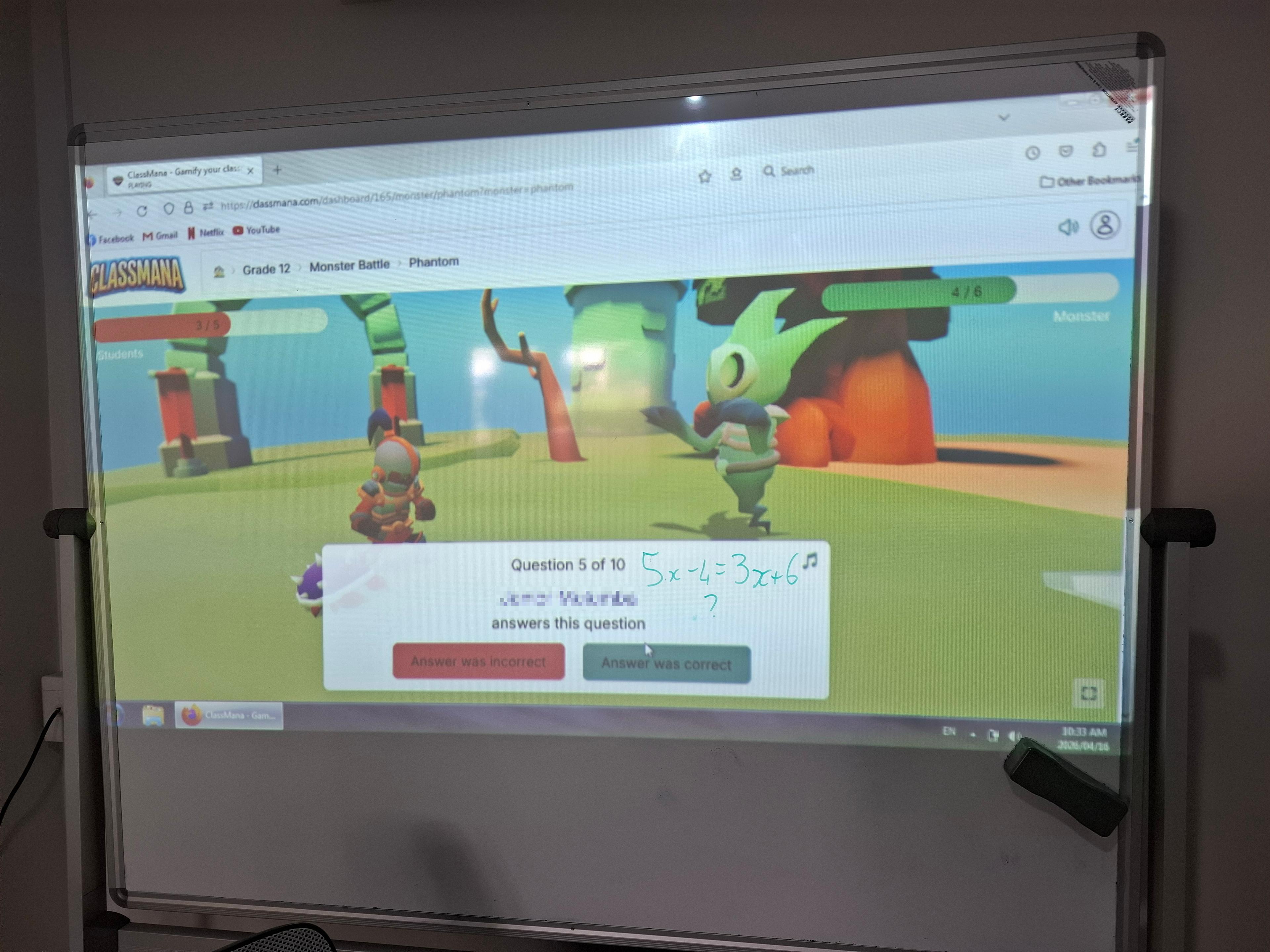
I have the page open and ready before students even enter the classroom, as learners can earn points for being the first students seated and ready with their stationery out.
Read the full interview with Dan, including the story of the shy student who
yelled at a classmate to get to her seat first.
2. Set a few clear rules and many procedures
Three to five rules are enough: be on time, be ready, respect people and property. What older students need more is
procedures: exactly what to do when they need the bathroom, a pencil, or help, when they finish early, and where
their phone goes. Every procedure you teach is a question you don't have to answer twenty times a day.
Write the rules with the class in the first week. Students follow rules they helped make more readily, and they can't
claim they never heard them.
3. Learn their names and talk to them outside the lesson
Relationships do more for behavior in secondary school than any system. A simple way to start is the "2×10" strategy:
talk with a difficult student for two minutes a day, ten days in a row, about anything except schoolwork. Their favorite
game, their weekend, their sport. A student who feels known has a reason not to ruin your lesson.
4. Correct in private, praise specifically
When a student misbehaves, go to their desk and correct them quietly, or ask them to step outside for a moment. You take
away the audience, and with it the need to save face. The same goes for praise: many teenagers would rather hear "that
argument in your essay was really strong" quietly at their desk than in front of everyone.
5. Reward much more than you correct
It's easy to notice only the students who are causing problems. A useful habit is to aim for several positive comments
for every correction. In ClassMana, rewards and warnings are logged, so I can check how secondary teachers do this in
practice: in the 92 secondary classes I looked at, teachers gave 9.3 rewards for every warning. In classes named
after a primary grade, it was 8.0.
The data can't tell why. My guess is that a points system only survives with teenagers when it's mostly positive: if it
feels like a list of punishments, students simply stop caring about it.

Teacher on Reddit
It's a way of recognizing the positive things they do and curbing the negative
without it being a big power struggle or something that they can't bounce back from.
6. Reward with privileges
Older students don't want prizes. They want privileges: a bit of freedom in a day that is mostly decided for them. And
when they can choose, they use them a lot. In ClassMana, students spend mana on "powers", privileges that the teacher
defines. Powers were used in 80% of the secondary classes I looked at, against 62% of the primary classes. Students
also spent gold in the class shop in 64% of secondary classes, against 41% in primary.
Which privileges? These are the default powers, and how many of the secondary classes that offered them actually used
them:
| Privilege | Offered in | Used in |
|---|---|---|
| Change your seat | 34 classes | 15 |
| Get an extra day for an assignment | 25 classes | 12 |
| Can drink in class | 15 classes | 7 |
| Get a hint to a question | 36 classes | 8 |
| Work with a partner on an individual assignment | 30 classes | 6 |
| 5 minutes to do whatever you want (quietly) | 22 classes | 3 |
| Choose not to answer a question | 27 classes | 1 |
Choosing a seat and a little more time are the clear favorites. Skipping a question was offered in 27 classes and used
in one. Teenagers will spend their points to sit next to a friend, but apparently not to get out of answering. For more
ideas sorted by age, see
Classroom Reward Ideas: 60 Free Rewards Students Actually Want.
How I counted: ClassMana classes don't have a grade field, so I counted as "secondary" every class whose name contains
a class period ("Period 3", "4th hour", "Block 2") or grade 6 to 12, and which had at least 50 rewards and warnings: 92
classes from 44 teachers. Primary classes are the 63 classes named after grades 1 to 5. Most classes have no grade in
their name, so this is a small sample, and teachers may have renamed or deleted powers. Aggregated counts only, without
looking at individual students or classes.
7. Give real choices
Autonomy is what teenagers want most, and you can give it without losing control. Let them choose between two tasks, the
order they do things in, the format of a project or who they work with on Friday. Each choice is small, but a class that
makes many small choices feels less pushed around, and pushes back less.
8. Use the group: team goals, not leaderboards
Older students care about their peers, so use that. Team goals turn peer pressure into peer support, while a public
leaderboard mostly embarrasses the students at the bottom.
Wu Chang Hsin, a chemistry teacher for grades 10 to 12 in Taiwan, gives students extra Experience when they heal a
teammate in his classroom game, so helping each other pays. Dan Taviv uses a whole-class stake: the class only gets its
daily random event when not too much of the lesson went to behavior problems.
If a class is misbehaving or too much time is needed to deduct health or manage incomplete homework, then we do not get to the event. This has made students more aware of their behaviour, as they know they can lose something they enjoy.
9. Keep the lesson moving
Most misbehavior in secondary school starts in dead time: waiting for the teacher, a long explanation, or students who
finish early. Change the activity every 15 to 20 minutes, give early finishers a standing task, and call on students at
random so that everyone has to stay ready.
Costanza Cossu, who teaches math and science at a middle school in Italy, uses a random student picker "all the time"
and says it makes assessment moments less stressful and more playful. Read
her interview for how she uses it.
10. Have a phone routine
Phones are the biggest management problem in many secondary classrooms. Whatever your school's policy, make the routine
the same every day: phones in bags, in a pocket chart by the door, or face down in the corner of the desk. Then reward
the habit. Wu Chang Hsin gives Experience to students who hand in their phones on their own to stay focused, which turns
a rule into a choice students get credit for.
11. Make noise visible
"Keep it down" means something different to every student. A noise meter on the board shows the class exactly how loud
it is, so you don't have to keep repeating yourself. A class goal (stay under the line for ten minutes) works better
with teenagers than calling out individual students.
High school teacher on Reddit
I found out about Classmana midway through the school year and was running it in all my high school classes the next
day utilizing all the features especially
the dragon to keep the volume down during independent work time.
For the tools, see Free Classroom Noise Monitors: 7 Options Compared.
12. Use one system across all your classes
With five or six groups a day, you can't run a different system in each one. Use the same rules, procedures and rewards
in every class, so you only have to remember one set, and students who talk to each other between periods find that it's
fair. Keep the system fast: if giving a reward takes more than a few seconds, you'll stop doing it in your busiest week.
Middle school vs. high school: what changes
The strategies above work from grade 6 to grade 12, but the emphasis shifts:
| Middle school (ages 11–14) | High school (ages 14–18) | |
|---|---|---|
| What they care about | Friends, fairness, fun | Grades, independence, their future |
| Rewards that work | Choosing a seat, a partner, team points, avatars and levels | Extra time, a late pass, flexibility, privileges tied to grades |
| Biggest management problem | Energy, talking, testing limits | Phones, apathy, missing work |
| How to correct | Quickly and privately, with a clear way back | Privately, as a conversation between adults |
Middle schoolers still enjoy a game, as long as it doesn't look made for young children. High school students will play
along when the game connects to something they care about. Wu Chang Hsin, for example, ties participation grades to the
level of each student's character.
How ClassMana fits in a secondary classroom
This is the part where I tell you about the thing I make, so feel free to skip ahead to the FAQ.
ClassMana is a classroom management game built so that older students don't outgrow it. The shortest way I can describe
it: a ClassDojo for older students. Students earn Experience for the behaviors you choose, level up a 3D avatar, and
spend mana on powers, the privileges you define (like the ones in the table above). Warnings lower health without taking
away anything a student has earned, and a student who falls can make up for it with a positive action. Teams let
students support each other.
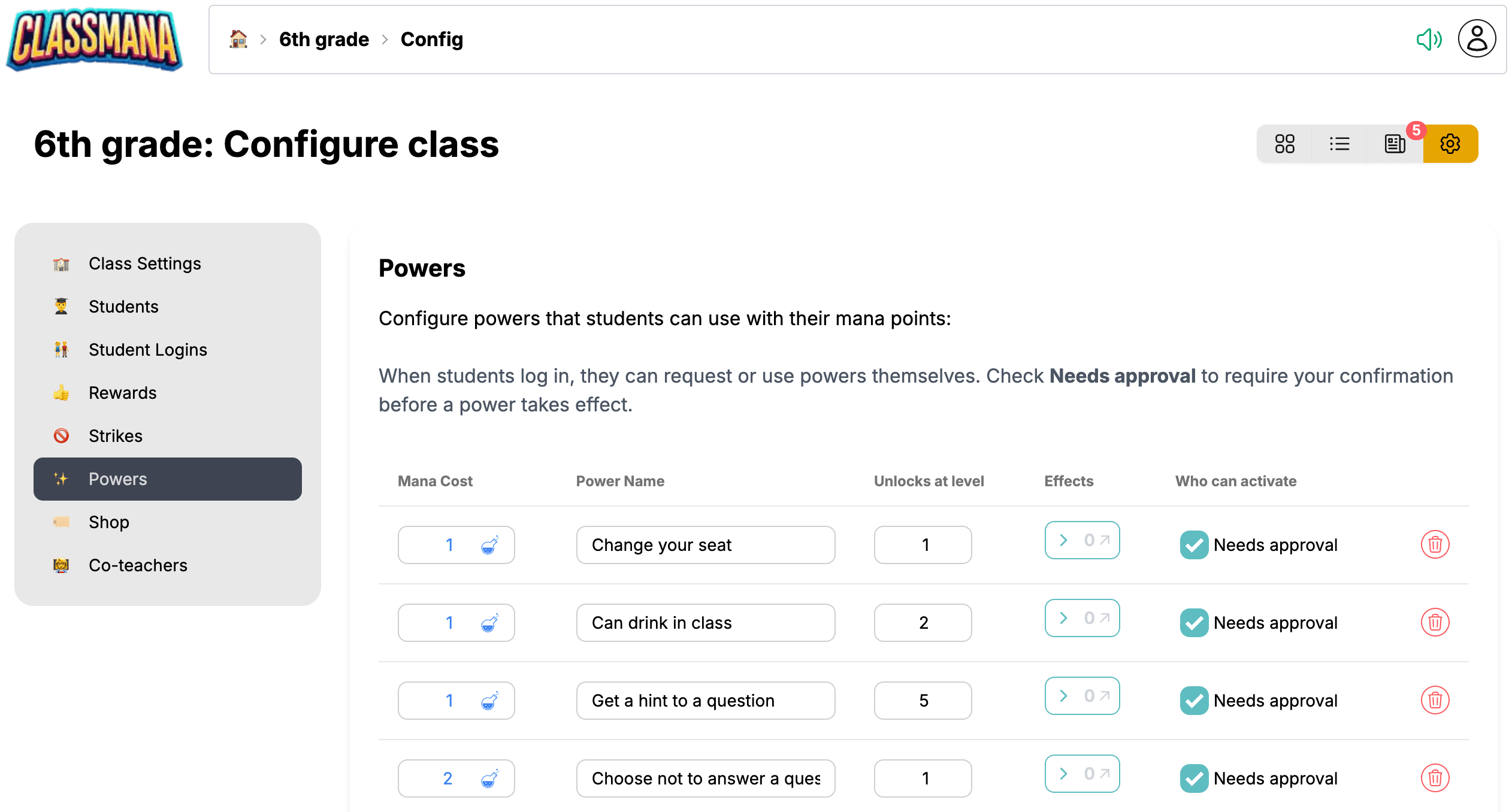
For secondary teachers there are two practical things. You can
share your setup across all your
classes, so you configure rewards, warnings and powers once. And students log in with their first name and a code, with
no email address or account needed.
What it doesn't do: it has no parent messaging and no native app (it runs in the browser on any device). It costs $75
per year per teacher in the US (€65 in most of Europe), and you can try it with a free class for three weeks. If you're
comparing it with ClassDojo, see our ClassDojo alternatives and
gamification tools for middle and high school.
Frequently asked questions
What is the best classroom management strategy for middle school?
Clear routines from the first minute of class, combined with private correction and frequent, specific praise. Middle
schoolers test limits and care what their friends think, so predictable procedures and corrections that don't happen in
front of the class prevent most conflicts.
How do you manage a high school classroom?
Treat students like young adults: a few clear rules, consistent procedures, private conversations instead of public
reprimands, and privileges they care about, like extra time or seat choice. Build relationships with individual
students, and use the same system in every class you teach.
How do you discipline a middle school student?
Correct the behavior quickly, calmly and privately, with a consequence the student knew about in advance. Then give them
a way back, so one mistake doesn't define their week. Public shaming and long lectures usually make the behavior worse,
because the student has to save face in front of their peers.
What is the 10-10 rule in middle school?
The 10-10 rule means students don't leave the classroom (for the bathroom or a drink) during the first ten and the last
ten minutes of a lesson. It protects the start and end of the lesson, when instructions and wrap-up happen.
Do reward systems work in high school?
Yes, when the rewards are privileges older students value, like choosing a seat, getting an extra day on an assignment
or listening to music during independent work. In ClassMana, students used privileges in 80% of the secondary classes we
looked at. Stickers and small prizes work much less well with teenagers.
Is ClassDojo good for middle school?
ClassDojo is free and strong at parent communication, and in 2026 it added teacher-to-student messaging for grades 6–12. Its game side is
light, though: the focus is on points, skills and communication with families. Teachers who want a system that teenagers
don't outgrow often look at alternatives like ClassMana. See
ClassDojo alternatives.
Is there a classroom management app for high school?
Yes. ClassDojo and LiveSchool track behavior points, ClassBank runs a classroom economy, and ClassMana turns behavior
management into a classroom game with avatars, levels and privileges, used from middle school to university. ClassMana
costs $75 per year per teacher in the US (€65 in most of Europe), with a free three-week trial class.
Try it in your classes
The moral of the story? Teenagers don't need a softer version of primary school classroom management. They need
structure that respects them: clear routines, private correction, privileges worth earning and a system that is the same
in every class.
If you want that system to keep track of itself, try ClassMana in one of your classes. For more
ideas, see 12 Classroom Management Games and
Classroom Management Apps for Teachers.
Join the Conversation! Have thoughts or questions about this article? Join our ClassMana Facebook Community to share your ideas, ask questions, and connect with other like-minded educators!