
November 9, 2026
Classroom Economy: How to Set Up a System That Still Works in May
A classroom economy is a system where students earn a classroom currency and spend it on things they want. They earn it
for jobs, effort, behavior or learning, and they spend it in a class store, on privileges, or on "rent" for their desk.
It turns abstract expectations into something students can count, and it gives younger students their first hands-on
experience with earning, saving and spending.
Most classroom economies start strong in September. By spring, many have quietly stopped: the teacher is behind on
paydays, half the class is rich, the other half has given up, and nobody cares about the store anymore. This guide shows
how to set one up so that doesn't happen, with what to decide first, eight setup steps, and the fixes for the problems
that end most economies early.
Full disclosure: we make ClassMana, a classroom game with a built-in gold economy and class
shop. Everything in this guide also works with paper money and a spreadsheet.
First, decide what your economy is for
There are two kinds of classroom economy, and they need different designs:
- A financial-literacy economy teaches money skills. Students apply for classroom jobs, receive a salary, pay rent or bills, keep a bank balance and maybe earn interest. The economy is part of what you teach, so it's worth the extra time it takes.
- A motivation economy rewards effort and behavior. Students earn currency for doing the things you want more of and spend it on rewards. There are no bills or bank accounts, because the goal is a positive class climate, not economics.
Both are valid. The mistake is building the first when you want the second: a full economy with jobs, rent and fines
takes a lot of class time to run, and if money skills aren't your goal, that time is wasted. If you're not sure, start
with a motivation economy and add jobs or rent later. Adding rules is easy; taking them away mid-year is not.
How to set up a classroom economy in 8 steps
1. Pick the currency
Give it a name students will use: dollars with your name on them, "class bucks", gold coins, points, or something tied
to your class theme. Then decide its form:
- Paper money is tangible and great for younger students, but it gets lost, traded and counterfeited.
- A ledger or spreadsheet is free and can't be stolen, but every transaction goes through you.
- An app keeps the balances for you and lets students check their own, which saves the most time.
2. Decide how students earn
Write down every way to earn, with a fixed amount for each. Students need to know the rules before the first payday.
Common sources:
- Classroom jobs, paid weekly (see the job list below)
- Routines: on time, prepared, homework handed in
- Effort and behavior: helping a classmate, staying on task, a great discussion contribution
- Academic milestones: finishing a unit, improving a test score, reaching a reading goal
- Class goals: a bonus for everyone when the whole class reaches a target
Keep it to a handful of sources. Ten earning rules are hard to apply consistently, and inconsistency is what students
notice first.
3. Decide what costs money
This is what makes the currency worth something. Options, from simplest to most realistic:
- Store items and privileges only (the motivation economy)
- Desk rent, paid weekly, so students learn that income has to cover costs
- Bills and fines for things like a lost pencil or a late assignment
- Savings with interest, to teach delayed gratification
Rent and bills only make sense in a financial-literacy economy. In a motivation economy, they turn a reward system into
a punishment system.
4. Build the class store
The store is the engine of the economy. If students don't want what's in it, nothing else matters. Build a price ladder:
- Small items that cost about one week of typical earnings (a sticker, choose your seat for a day)
- Medium items for two to three weeks (homework pass, lunch with the teacher)
- Big items for a month or more (a class party vote, being the teacher's assistant for a day)
Privileges cost you nothing and often beat prizes. The store ideas section below has lists by age.
5. Choose your bookkeeping
Decide who records what, and when. With paper money, students hold their own cash. With a ledger, a student banker can
update balances (and you check them). With an app, you award in a click and balances update themselves. Whatever you
pick, the test is simple: can you keep it up during your busiest week of the year? If not, simplify now.
6. Introduce it in one lesson
Explain how to earn, what things cost and when payday is. Hand out a starting balance, so everyone can afford something
small in the first week. Then open the store early. Students believe in an economy once they've bought something with
it.
7. Keep a payday rhythm
Pick one fixed moment: Friday afternoon, or the last five minutes of the week. Regular paydays and a regular store day
are what keep the economy alive. When paydays slip, students stop trusting the currency.
8. Review it once a month
Look at the balances. Is the store emptying or full? Are a few students getting rich while others have nothing? Adjust
prices, add new items, and change one rule at a time. Tell the class what you changed and why.
Classroom economy jobs
Jobs give students responsibility and a steady income. Pay them the same amount every week, and rotate them (monthly
works well) so everyone gets a turn at the popular ones.
| Job | What they do | Works best in |
|---|---|---|
| Banker | Records deposits and payments, checks balances | Grade 3 and up |
| Store clerk | Runs the class store on store day | All grades |
| Paymaster | Hands out salaries on payday | Grade 3 and up |
| Auditor | Double-checks the banker's records | Grade 4 and up |
| Attendance keeper | Takes attendance or tracks who's on time | All grades |
| Materials manager | Hands out and collects supplies | All grades |
| Tech assistant | Sets up the board, helps classmates log in | Grade 3 and up |
| Messenger | Takes messages to the office | Elementary |
| Class reporter | Writes the weekly class news or announcements | Grade 4 and up |
| Clean-up inspector | Checks the room before the bell | All grades |
| Substitute | Fills in when someone is absent (and earns their pay) | All grades |
In middle and high school, let students apply for jobs with a short written application. The application itself becomes
a lesson.
Classroom store ideas
Free privileges (they cost nothing and work at every age):
- Choose your seat for a day
- Sit at the teacher's desk
- Pick the class music during independent work
- Skip one homework question
- Be first in line, or first to choose a group
- Use a pen color of your choice on a test
- Five minutes of free time
Academic items:
- Homework pass
- Retake one quiz question
- A notes card for a test
- Extra time on one assignment
Things to buy:
- Stickers, pencils, erasers
- A small snack (check your school's food rules)
- A class reward the whole class saves for together, like a movie afternoon
For middle and high school:
- Phone time during the last five minutes
- Late pass for one assignment
- Choose the review game
- Drop the lowest homework grade
Pricing and the problems that end most economies
Most economies fail for the same few reasons. Here's how to prevent each one.
Inflation. If you hand out too much, prices stop meaning anything. Before you start, estimate what a typical student
earns in a week, and price your small items at about that amount. If everyone can buy the big items by October, raise
the prices of new items rather than paying less.
The rich get richer. A few students earn far more than everyone else, and the rest give up. Fix it with more ways to
earn that don't depend on being the best: effort, improvement, helping, jobs. Class-wide goals help too, because
everyone gets paid when the class succeeds.
Hoarding. Some students save everything and never spend, so the store stops motivating them. Add a few expensive,
limited items worth saving for, or hold an auction every month or two.
Stale store. The same items all year get boring. Rotate a few items every month, and ask students what they'd like
to see. They often suggest cheap privileges you'd never think of.
Absent students. Decide in advance whether absent students still get their job pay. Most teachers pay them, so
students don't lose out because they were sick.
Too much bookkeeping. This is the most common reason economies stop. If you're spending more than a few minutes a
day on it, give the bookkeeping to student jobs, or move it to a spreadsheet or an app.
Should you fine students?
Fines are the most argued-about part of a classroom economy. Some advice:
- Use them sparingly. If fines are the main way the currency moves, students experience the economy as punishment.
- Never let a balance go below zero. A student who is deep in debt has no reason to try.
- Keep serious behavior out of the economy. Fining a student for hurting a classmate makes it a transaction they can afford. Handle those with your normal consequences.
- Fine for things that have a real-world cost, like a lost book or a late assignment, if your goal is financial literacy.
A classroom economy in middle and high school
Teenagers will see through a sticker store. What works with older students:
- Privileges over prizes. Phone time, a late pass or choosing the review game matter more than candy.
- Real concepts. Interest on savings, taxes on salaries, a simple budget, or a stock-market week tied to your class data.
- Student-run systems. Let students be the bank, the auditors and the store. They hold each other to the rules.
- Teams. A group that earns and spends together adds cooperation and some healthy competition.
- Less paper. High school students handle their own balances well in an app, and it saves you the bookkeeping across five class periods.
- A game around it. Older students engage more when the currency is part of something bigger, like a character that levels up or a class story, than with money alone.
Paper, spreadsheet or app?
| Option | Cost | Time to run | Best for |
|---|---|---|---|
| Paper money | Printing | High | Younger students, financial-literacy lessons |
| Spreadsheet | Free | Medium | Teachers who want full control and don't mind data entry |
| App | Free to paid plans | Low | Busy teachers, several class periods, older students |
We compared the apps in detail in Best Classroom Economy Apps, including
ClassBank (a realistic economy with jobs and bank accounts), Critter Coin (school-wide houses) and ClassMana.
How a classroom economy works in ClassMana
In ClassMana, the economy is part of a classroom game, and it's deliberately simple. Students earn gold and spend it
in a class shop you set up. There are no jobs, salaries, rent or interest, so it's a motivation economy, not a
financial-literacy course.
- Earning: you decide which rewards give gold, and quest objectives can pay gold too. Awarding takes a click during the lesson.
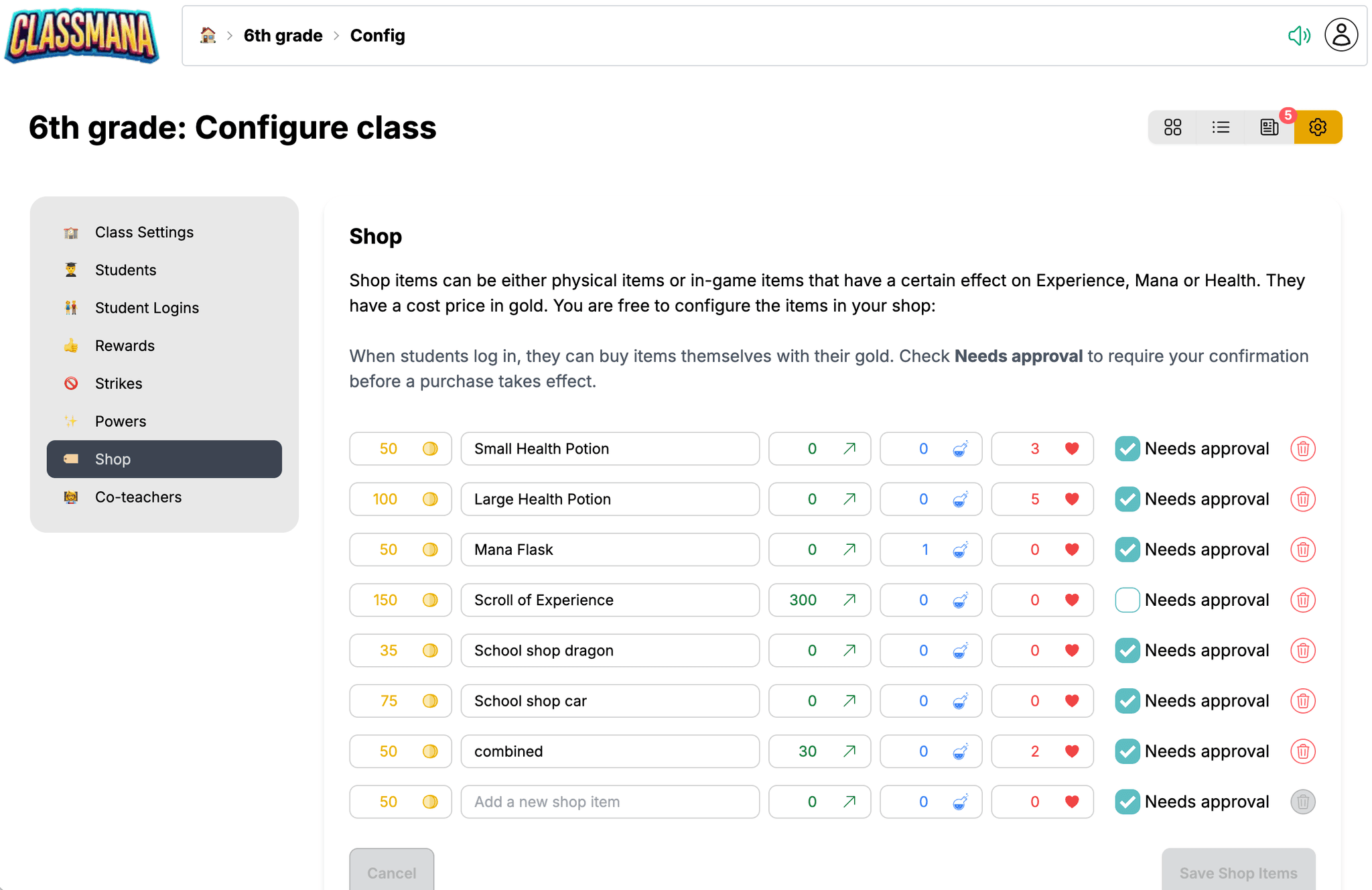
- The shop: you create the items and set the price in gold. Items can be real-life rewards (a homework pass) or in-game items that give Experience, mana or health. You can lock an item until a student reaches a certain level, and choose per item whether a purchase needs your approval.
- Fines: you set up warnings yourself, usually to lower a student's health. A warning can also cost gold, but it doesn't have to.
- Bookkeeping: students see their own balance and shop from their own screen. The Activity Log shows every purchase.
- Several classes: you can share your shop items across classes, so a grade-level team runs one economy.
Gold is one part of a bigger loop. Students also earn Experience to level up an animated avatar, mana to spend on
powers, and they play Monster Battles and Mystery Events as a class. That's what keeps the economy interesting in
spring: the store isn't the only thing to work toward. The full setup is in
Stage 4: Gold & Shop.
What teachers say
These are real comments from teachers who use ClassMana's gold and class store, quoted as they wrote them.

Teacher on Reddit
Scholars are completely bought in. I love the monster battles and can't wait to use the quest feature more.
Scholars love to spend their gold in the class store and change their avatar.
Teacher on Reddit
The store makes life a lot easier because the students can use it in there own
interface and they are PUMPED about the quests.

Chang-Hsin Wu
I really like the gold coin feature right now; it allows gamified classroom
management to extend into many interesting teaching designs.
Frequently asked questions
What is a classroom economy?
A classroom economy is a system in which students earn a classroom currency for jobs, behavior, effort or learning, and
spend it on rewards, privileges or classroom costs like desk rent. It's used to motivate students and to teach money
skills such as earning, saving and budgeting.
How do you start a classroom economy?
Decide whether the goal is financial literacy or motivation, pick a currency, write down how students earn and what
things cost, build a small store with a price ladder, and introduce it in one lesson with a starting balance. Then keep
a fixed weekly payday and store day.
What grade is a classroom economy for?
Any grade. In kindergarten to grade 2, keep it to earning and spending with tangible money. From grade 3, add jobs and a
student banker. In middle and high school, use privileges instead of prizes, add real concepts like interest and
budgets, and let students run the system.
What are good classroom economy jobs?
Banker, store clerk, paymaster, auditor, attendance keeper, materials manager, tech assistant, messenger, class
reporter, clean-up inspector and substitute. Pay each job a fixed weekly salary and rotate jobs monthly.
How much should items in a classroom store cost?
Price small items at about one week of a typical student's earnings, medium items at two to three weeks and big items at
a month or more. Check the balances every month and adjust the prices of new items if students can afford everything too
quickly.
Should you take money away in a classroom economy?
Sparingly. Fines for things with a real cost (a lost book, a late assignment) can teach responsibility, but if fines are
the main way money moves, the economy feels like punishment. Never let a balance go below zero, and keep serious
behavior out of the economy.
How do you run a classroom economy in high school?
Use privileges students care about (phone time, a late pass, choosing the review game), tie it to real concepts like
interest and budgets, let students run the bank and the store, and use an app so balances don't have to be tracked by
hand across several class periods.
Is there a free digital classroom economy?
Yes. ClassBank is free for individual K–12 teachers, Critter Coin is free for schools and teachers for the first 20,000
coins, and a shared spreadsheet costs nothing. ClassMana's gold and shop are part of its paid plans (from $75 per year
per teacher in the US, €65 in most of Europe), with a free three-week trial class. See our
comparison of classroom economy apps.
How long does it take to set up a classroom economy?
Plan one or two hours to decide the rules, make the job list and stock the store, plus one lesson to introduce it. After
that, a well-designed economy takes a few minutes a day. If it takes more, simplify it.
Try it in your class
If you want a classroom economy without the bookkeeping, try ClassMana. Set up your shop, award
gold in a click, and let students shop from their own screen. For more ideas to keep students engaged, see
12 Classroom Management Games.
Join the Conversation! Have thoughts or questions about this article? Join our ClassMana Facebook Community to share your ideas, ask questions, and connect with other like-minded educators!